The Resume Lab is a free resume builder we designed, built, and deployed end-to-end. You type on the left, a formatted, recruiter-ready resume renders live on the right, and you export a clean PDF in one click — no sign-up, no paywall, and nothing about your resume ever leaves your browser.
This is a detailed write-up of how we built it: the problem it solves, the technical stack, the architecture decisions, and the things we learned shipping a real product used by job seekers every day.
The problem
Building a resume in 2026 is still weirdly painful. The free tools bait you with a nice template and then hold your PDF hostage behind a $15 "unlock" at the final step. The genuinely free options look dated, and a worrying number of them export a resume that an Applicant Tracking System (ATS) can't actually read — so the resume never reaches a human at all.
We wanted to build the tool we wished existed: a genuinely free resume builder that is fast, looks modern, produces ATS-safe output, and respects your privacy. No dark patterns, no account required, no selling data.
That single principle — free and private by default — drove almost every decision that followed.
What it does
The core of the product is a live editor. As you fill in your details, a print-accurate preview of your resume updates in real time beside you. What you see is exactly what exports.
The main features:
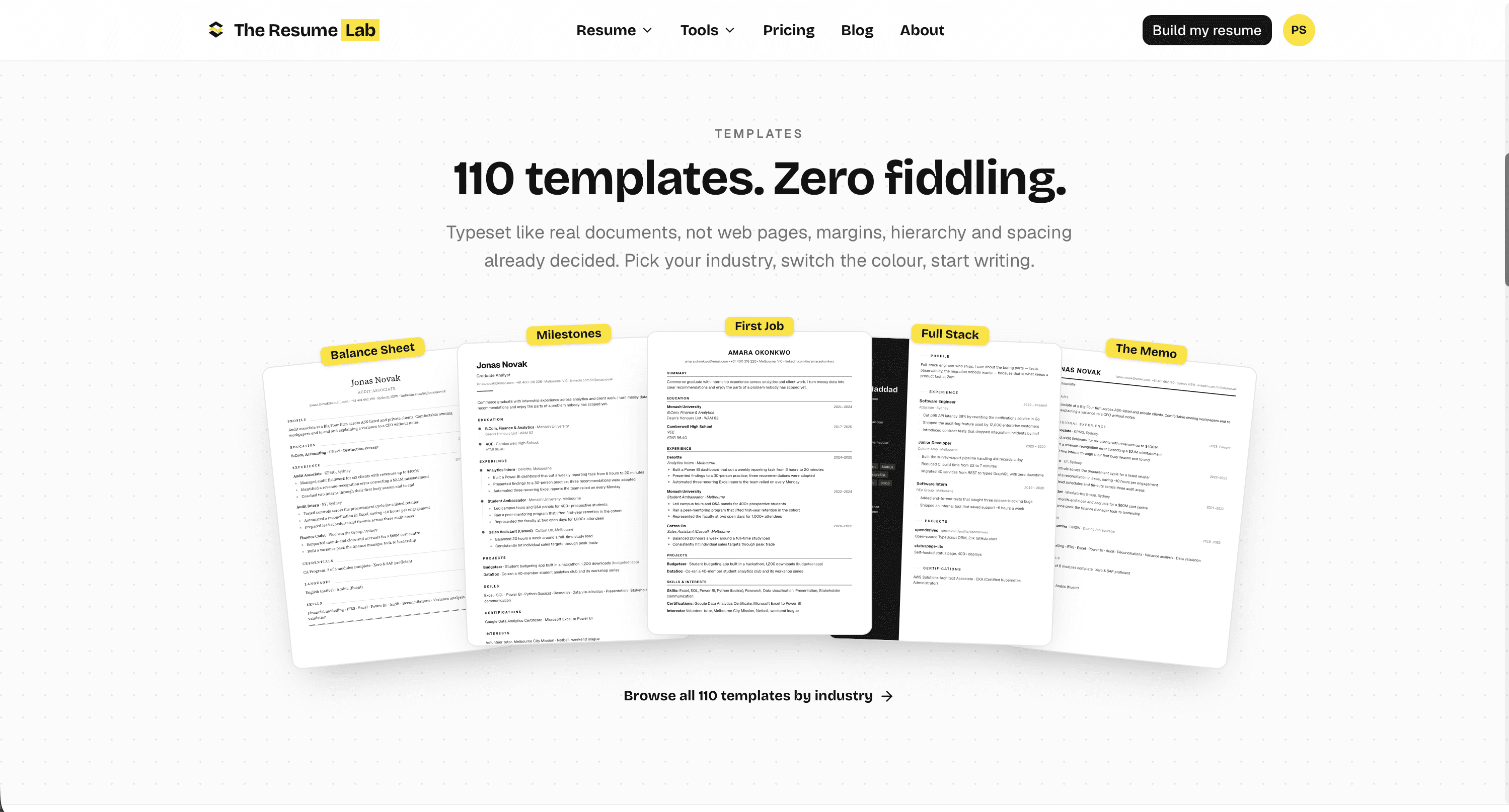
- 110 ATS-friendly resume templates, organised by industry, all built to parse cleanly through automated screening.
- A live resume editor with instant preview and a built-in ATS compatibility check.
- One-click PDF export that matches the on-screen layout pixel for pixel.
- A cover letter tool and LinkedIn optimisation tools to round out the job-search kit.
- Private by default — resume content is stored locally in your browser, never on our servers.
The stack
We built The Resume Lab as a modern web application, not a page-builder site. The stack:
- Next.js (App Router) for routing, server rendering of the marketing and template pages, and clean SEO out of the box.
- React + TypeScript for the editor — a stateful, interactive app where type safety genuinely pays off.
- Tailwind CSS for a consistent design system across 110 templates without a stylesheet spiralling out of control.
- Vercel for deployment, edge caching, and preview builds on every push.
The marketing pages (home, templates gallery, pricing, blog) are statically generated for speed and search visibility. The builder itself is a client-side React app — because the entire point is that your data stays on your device.
Architecture: keeping resume data private
The defining constraint was privacy. If we're promising that your resume never leaves your browser, the architecture has to make that literally true, not just a policy.
So the editor holds all resume state in React and persists it to the browser's local storage. There is no "save to account", because there is no account and no server-side database of resumes. Refresh the page and your work is still there; close the browser on your own machine and it's still there — but it was never transmitted anywhere.
This has a nice side effect: the app is effectively offline-capable for the editing experience, and there's no per-user backend cost to scale. It also sidesteps an entire category of security and compliance risk — you can't leak a database of resumes you never collected.
The hard part: ATS-safe PDF export
Making a resume look good is easy. Making it look good and parse correctly through an ATS is the actual engineering problem, and it's where most free builders quietly fail.
Applicant Tracking Systems read the underlying text and structure of a PDF, not the picture. A resume laid out with multi-column CSS, text inside images, or fancy absolute positioning often reads back to the ATS as scrambled nonsense — the candidate looks unqualified purely because of formatting.
So every one of the 110 templates is built against a set of rules: a logical reading order in the document, real selectable text (never text baked into an image), standard section headings the parsers recognise, and layouts that degrade to a clean single-column text stream. The visual variety lives in typography, spacing, and accent colour — not in structural tricks that break parsing.
The built-in ATS check runs against the same rules and flags anything in the user's content that would trip a parser, before they apply for a job with it.
Performance and SEO
Because it's a free tool competing on organic search, speed and SEO aren't optional — they're the growth channel.
Static generation on Next.js means the template gallery and landing pages ship as fast HTML with minimal JavaScript. The heavier editor bundle only loads on the builder route, so someone landing on a template page from Google gets a near-instant paint. Every page has proper metadata, canonical tags, structured data, and a clean URL structure — the same SEO fundamentals we bake into every build.
What we learned
Local-first is underrated. Building the whole product around browser storage removed enormous complexity — no auth, no database, no sync conflicts — and turned "we protect your privacy" from a marketing line into an architectural fact. For a lot of tools, the backend you don't build is the best decision you make.
ATS compatibility is a real feature, not a checkbox. It shaped the template system from the first line of CSS. Retrofitting it later would have meant rebuilding every layout.
Free changes the design brief. With no paywall to hide behind, the product has to earn trust in the first ten seconds. That pushed us toward instant preview, zero friction to start, and an export that just works — because there's no upsell moment to lean on.
See it live
The Resume Lab is live and free to use right now at theresumelab.co. If you're job hunting, build a resume with it — and if you're a founder or business with a product idea like this, that's exactly the kind of thing we build.